At 4,000 m below the surface, seawater pressure reaches about 400 times the pressure at sea level. Robots work there because they replace air-filled parts with pressure-tolerant housings, oil, or solid materials, then send data through a cable or acoustic link.
- ROVs stay connected: A surface ship sends power and commands through a tether.
- AUVs work alone: An onboard battery, computer, and sensor set guide the vehicle.
- The seafloor is slow to map: Water blocks radio signals, so sound carries most messages.
Two main robot types
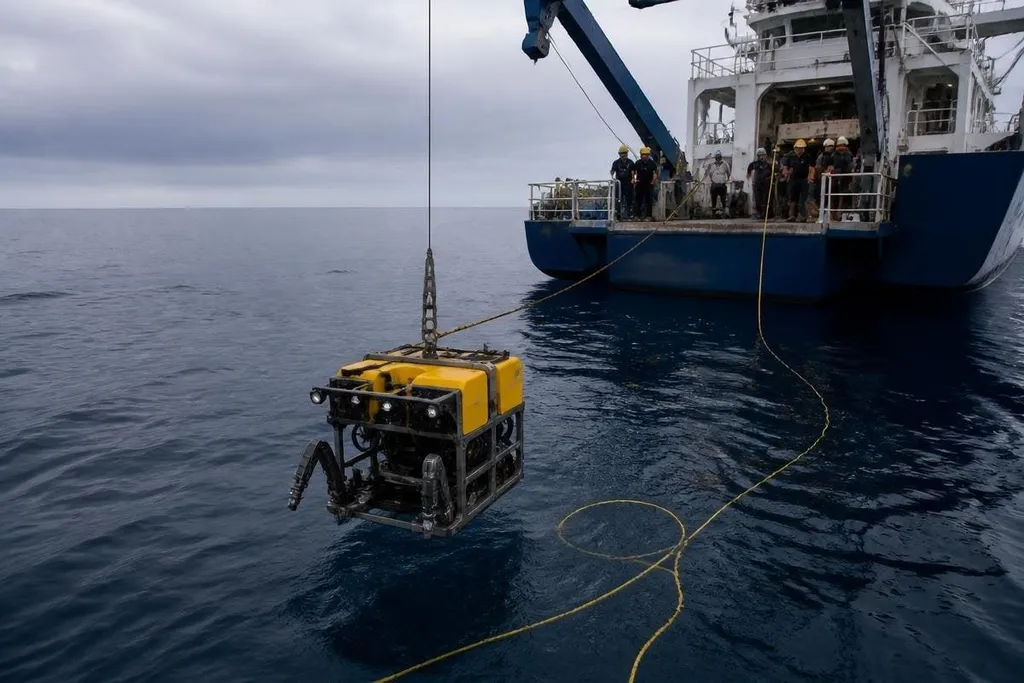
A remotely operated vehicle, or ROV, gets power and commands from a ship through a tether. The cable can carry electrical power down to the motors, lights, cameras, and robotic arms, while fiber-optic lines send video and control data back up.
The ship crew watches the ROV through cameras and sensor readings. They can move its thrusters, point a camera, collect a sample, or turn a valve without sending a person into the water. The tether also keeps the vehicle connected when the crew needs a steady video feed.
An autonomous underwater vehicle, or AUV, carries its own battery and computer. It follows a planned route with sensors such as sonar, depth sensors, cameras, and inertial measurement units. An inertial measurement unit tracks changes in motion, helping the vehicle estimate its position when GPS signals cannot reach it.
AUVs suit survey work because they can cover an area without a cable dragging behind them. They must still return to a known recovery point, surface for pickup, or meet an underwater docking station to send back large data sets.
How the robot knows where it is
GPS works at the surface, but radio waves fade quickly in seawater. Deep-ocean robots instead combine several signals. Depth sensors show how far down the vehicle has moved, while sonar measures distance from the seafloor or nearby objects.
Many systems also use acoustic markers placed on the seafloor or carried by a support ship.
The robot measures the time taken for sound to travel between the marker and its own sensors. That gives an estimate of position, though sound speed changes with temperature, salinity, and depth.
This is why an underwater map can contain small position errors even when the vehicle follows its route well. A robot may know its depth accurately while its side-to-side position drifts over a long survey.
How machines survive the pressure
A deep-sea robot cannot treat its electronics like equipment on land. Engineers place cameras, computers, and sensors inside pressure housings made from materials such as titanium or thick glass. Each housing must keep its shape while water pushes inward from every direction.
Some parts use a different method. Motors and electronics can sit inside oil-filled sections that are close to the surrounding water pressure. The oil keeps seawater away without forcing the housing to hold a large pressure difference.
Small details matter. A failed seal can flood an electronics housing, and a damaged connector can stop a tool far from the ship. ROVs also need lights because sunlight disappears well above the seafloor, while cameras must handle dark water, suspended sediment, and glare from their own lamps.
Those limits shape the work below the surface. Robot24.com underwater robotics reporting can help you compare each vehicle’s tools and working depth before looking at what robots can do on the seafloor.
What robots can do down there
ROVs often carry a tool frame with interchangeable equipment. A manipulator arm can hold a sample tube, turn a handle, or place a sensor. Sonar can map terrain when the water is too cloudy for cameras, and a suction tool can collect loose material from the seafloor.
AUVs are better suited to repeated survey lines. They can record seabed shape, water conditions, or images over a planned route, then bring the stored data back to the surface. Their battery limits how long they can stay down, while an ROV's tether limits how far it can travel from the ship.
The work remains slow. A ship may need to lower the vehicle, find the target, keep station over it, and recover the robot after the task. A camera view can also hide scale, so teams use lasers or known-size tools beside an object before judging its size.
A practical choice guide
Use this checklist before choosing a deep-ocean robot:
- Need live video? Choose an ROV with a tether, surface power, and a suitable camera system.
- Need long survey lines? Check an AUV's battery time, route control, and recovery plan.
- Expect heavy silt? Add sonar because cameras may lose useful detail.
- Need samples or repairs? Confirm the arm's reach, payload, and tool fit.
- Working below 4,000 m? Check the pressure rating for every housing and connector.
- Sending large files? Plan for onboard storage, since acoustic links carry far less data than fiber.
The best vehicle depends on the job. I'd choose an ROV for inspection or repair, where a person needs live control, and an AUV for a planned survey that covers ground without a tether.
The hard limit is recovery: every deep-sea mission needs a ship, a launch plan, and a way to bring the robot back with its data intact.